
Flexible Stone Veneer Sheet Exporter in Rajasthan, India: What Global Buyers Should Know
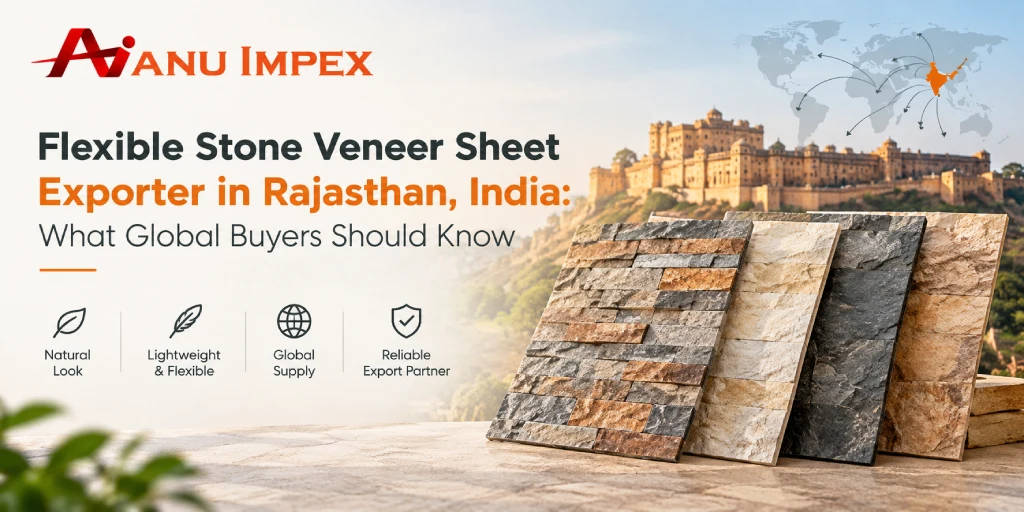
Stone has always been heavy, brittle and costly to move. Flexible stone veneer changed that by lifting a sliver of real rock off a block and bonding it to a bendable backing, and much of that material now ships from workshops around Jaipur, Jodhpur and Udaipur. For overseas buyers, picking a flexible stone veneer sheet exporter in Rajasthan, India comes down to quarry access, finishing discipline and export paperwork. This guide covers each of those, along with the questions worth asking before a container gets booked.
A Rajasthan-based exporter of flexible stone veneer supplies thin sheets of natural stone, usually 1 to 2 mm thick, bonded to a flexible backing and shipped in sizes such as 1220 x 610 mm. Buyers should check stone origin, sheet consistency, test reports and export paperwork before placing an order.
Why Rajasthan Became a Centre for Thin Stone Production
Rajasthan sits on one of India’s densest stone belts, which explains why so many thin stone veneer sheet suppliers cluster here. Sandstone from Jaisalmer, Dholpur and Bundi, Kota stone, Makrana marble and assorted quartzite and schist deposits all come out of the state, and cutting workshops have operated around Jaipur, Jodhpur and Kishangarh for generations.
That history matters because veneer depends on skilled hands as much as raw material. Splitting a layer under two millimetres thick from a stone block, without cracking it or leaving the surface patchy, takes workers who read grain the way a carpenter reads timber. Rajasthan already has that labour pool.
Logistics add to the advantage. Inland container depots near Jaipur and Jodhpur move cargo by rail to Mundra and Nhava Sheva, two of India’s busiest container ports, so cargo usually reaches a vessel within days rather than weeks. For buyers in the Gulf, Europe or North America, a flexible stone veneer sheet exporter in Rajasthan, India can therefore quote shorter delivery windows.
How Is Flexible Stone Veneer Made?
Flexible veneer starts as a block of natural stone, usually slate, quartzite, sandstone or mica schist, chosen for layered grain that splits cleanly. A thin slice, often well under 2 mm, is separated from the block and bonded to a backing of fibreglass cloth and polymer resin. The backing carries the strain; the stone supplies the look.
Quality shows up in the backing as much as on the surface. Cheap resin yellows under ultraviolet light, delaminates in humid warehouses and cracks when wrapped around a curved column. Better manufacturers cure sheets under controlled pressure and test the bend before packing.
Natural variation is part of the product. Two sheets from one lot will never match exactly, so careful exporters grade by colour and pattern and print batch numbers on every carton. Buyers covering a large façade should ask for a photo of the full lot before shipment.
What Makes Flexible Veneer Different From Solid Stone Cladding?
The difference comes down to thickness, weight and how the material is fixed. The comparison below uses typical figures for 1–2 mm veneer, 20 mm natural stone cladding and 8–10 mm porcelain tile.
Feature | Flexible stone veneer | 20 mm stone cladding | Porcelain tile |
Thickness | 1–2 mm | About 20 mm | 8–10 mm |
Weight | Roughly 3–8 kg per sq m | About 55 kg per sq m | About 20 kg per sq m |
Curved surfaces | Yes | No | No |
Fixing | Adhesive, blade or saw cutting | Anchors or heavy mortar | Adhesive, wet saw |
Weight is the figure that changes projects most. A square metre of 20 mm stone cladding puts roughly 55 kg on a wall, since natural stone weighs about 2.7 tonnes per cubic metre, while veneer adds a few kilograms. That gap shrinks freight bills, removes the need for heavy anchoring and lets designers dress lift cores, curved reception desks and ceilings that solid stone struggles to handle.
Limits exist. Veneer is a surface finish, not a structural material, and it is not built for heavy-traffic floors. It performs best on walls, columns, ceilings, furniture and shop fittings, where its flexibility and light weight count for more than raw durability.
What Should You Check Before Choosing a Flexible Stone Veneer Sheet Exporter in Rajasthan, India?
Start with proof of where the stone comes from and how the sheets are made. A reliable flexible stone veneer sheet supplier in Rajasthan will name the quarry region, identify the stone type and show factory images that match the samples. Exporters such as [Brand Name] usually share this without being asked, because transparent sourcing is what separates a manufacturer from a trader.
Samples and Test Reports
Ask for a sample of at least 30 x 30 cm cut from current production, not a showroom piece. Bend it, soak it overnight, scratch it with a key and fix it to a scrap panel with the adhesive you plan to use. Request lab reports covering water absorption, bond strength and, for commercial projects, fire performance of the backing.
Packing and Shipping
Packing decides whether sheets arrive intact. Look for sheets interleaved with protective paper, stacked flat in wooden crates or heavy cartons, and strapped to pallets. A single 20-foot container holds many thousands of square feet of veneer, so ask the exporter for a loading plan, the Incoterm quoted (FOB Mundra or CIF to your port are common) and the expected production time, which for standard colours often runs two to four weeks.
Wholesale Pricing and Payment
Wholesale pricing depends on stone type, thickness, grade and order size, so compare like with like. A flexible stone veneer sheet wholesale supplier in India will normally quote lower rates per square foot for full containers, while mixed-pallet orders carry a premium. Payment usually runs through a letter of credit or an advance of around 30 per cent with the balance against shipping documents, and manufacturers generally issue a commercial invoice, packing list, certificate of origin and bill of lading as standard.
Where Do Flexible Stone Veneer Sheets Work Best?
Hospitality and retail interiors are common uses. Hotel lobbies, restaurant feature walls and boutique storefronts use veneer because installers can wrap it around curved surfaces and finish a wall much faster than with solid stone.
Residential renovation is another natural fit. Because sheets weigh so little, they can go over existing plaster, plywood or tile in apartments where structural limits rule out stone cladding, which suits the retrofit market in older European and Gulf buildings.
Exterior use needs more care. Sheets with UV-stable backing and sealed stone surfaces can handle sheltered facades, porches and gate pillars, but buyers should confirm the manufacturer’s outdoor rating in writing and avoid areas with constant standing water.
Frequently Asked Questions
Which stones are used for flexible veneer sheets?
What size and thickness do the sheets come in?
What is the minimum order quantity for a wholesale order?
Can flexible stone veneer be used outdoors?
How long does shipping from Rajasthan take?
Paper comparisons only go so far with a material that is judged by touch and by how it bends. The most reliable way to choose a flexible stone veneer sheet exporter in Rajasthan, India is to order samples from two or three shortlisted factories, all in the same stone and thickness, and put them through identical tests.
Bend each one around a pipe, glue it to a board, leave it in water overnight and compare edges, colour and flex. The supplier whose sample survives, whose paperwork arrives on time and whose answers stay consistent is usually the one whose container will match what was promised.
