
How to Choose the Right Sandstone Circle Supplier in India for Bulk Orders
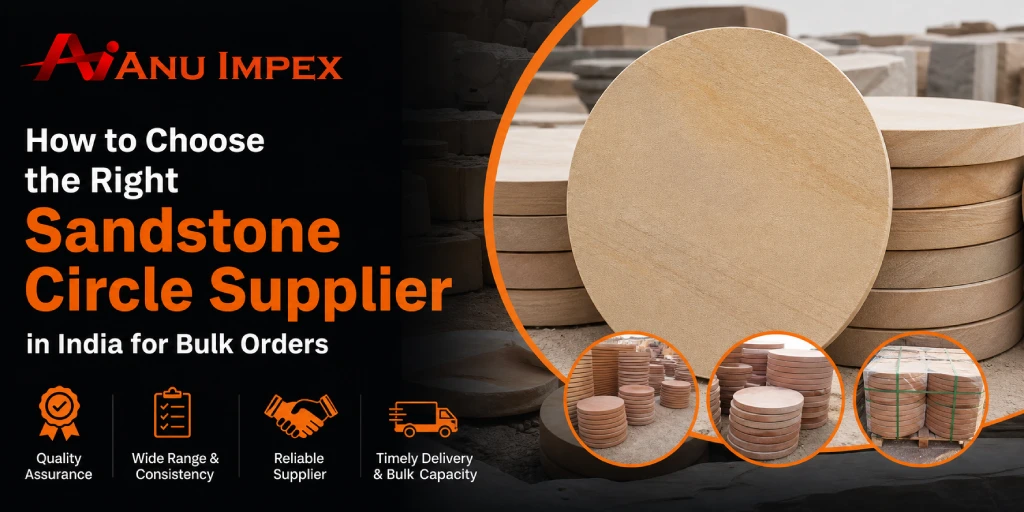
Bulk sourcing for a sandstone circle changes the moment you move from browsing a catalogue to actually placing a container-load order. Quantities that looked simple on paper suddenly involve block selection, kiln-dried curing time, pallet weight limits, and a supplier’s ability to hold color consistency across five hundred pieces instead of five. This guide walks through what separates a dependable sandstone circle supplier in India from one that will cost you a shipment.
A dependable sandstone circle supplier in India for bulk orders is one that quarries and finishes stone in-house, tests each batch for thickness and color tolerance, and can document lead times, packing methods, and freight costs before the order is confirmed – not after the deposit clears.
Why Rajasthan Dominates Sandstone Circle Production
Rajasthan produces the overwhelming majority of India’s export-grade sandstone, and the state’s Kota, Bundi, and Jodhpur belts each hold distinct stone characteristics that matter for a circle order. Kota stone runs denser and greener, Bundi yields the classic beige and pink tones, and Jodhpur quarries produce the harder, more weather-resistant blocks used in patio and paving circles.
Buyers searching for a sandstone supplier Rajasthan India connection usually land here first because the raw material, the cutting infrastructure, and the export documentation experience are concentrated in one region. That concentration cuts transport costs between quarry and finishing unit, which shows up directly in the final quote a bulk buyer receives.
A circle-shaped order is more demanding than flagstone or tile because every piece has to be cut on a radius, and radius cutting from a single slab wastes more stone than straight cuts do. Suppliers without CNC or hydraulic profiling machines often subcontract this step, which adds a hidden mark-up and a second point of failure in your supply chain.
How Does Supplier Location Affect Delivery Timelines for Bulk Circle Orders?
Location affects timelines more than most buyers expect, because circle pieces are heavier per square foot than flat-cut stone and inland freight from quarry to port adds real days. A supplier based within 150 kilometres of Kandla or Mundra port typically ships two to four days faster than one located deep in the interior belt near Jaisalmer.
Ask for the supplier’s actual factory pin code, not just their registered office address, since many trading companies list a Jaipur or Jodhpur city address while production happens hours away. That gap alone can add a week to your production-to-port window.
What to Check Before Signing a Bulk Purchase Order
Verification before payment protects a bulk buyer far more than any contract clause does, because Indian stone export disputes are slow and expensive to resolve internationally. Start by asking for the supplier’s IEC (Import Export Code) and GST registration, both of which are public-verifiable and take under ten minutes to confirm through government portals.
Sample consistency matters more for circles than for any other cut, because a mismatched sample-to-bulk ratio is visually obvious once pieces are laid in a curve. Request three samples from three separate slabs, not three pieces cut from the same block, so you can see genuine batch variation before committing to volume.
Physical factory visits remain the strongest verification method, and any sandstone wholesale supplier Rajasthan India buyers can visit in person before a large order should welcome the visit rather than discourage it. If travel isn’t possible, a live video walkthrough of the quarry, the cutting unit, and the loaded container is a reasonable substitute that most established exporters now offer as standard practice.
Below is a quick reference for the checks that matter most on a first bulk order:
Check | Why It Matters | How to Verify |
IEC & GST number | Confirms legal export status | Government portal lookup |
Multi-slab sampling | Reveals true color/texture variance | Request 3 samples, 3 slabs |
Factory address vs. office address | Confirms real production location | Ask for pin code, cross-check with maps |
Radius-cutting equipment | Determines circle accuracy and waste | Ask for CNC/hydraulic profiling proof |
Export history | Shows track record with similar orders | Request past shipping documents or references |
How Pricing Actually Works for Sandstone Circle Bulk Orders
Pricing on a sandstone circle order is quoted per square foot or per piece, but the number that lands on your invoice depends on diameter, thickness, and finish far more than most buyers realize going in. A 24-inch circle in a 25mm honed finish typically costs 15 to 25 percent more per square foot than the same diameter in a natural split finish, because honing adds a separate machine pass and more rejected pieces.
Freight is usually the second-largest cost after the stone itself, and it scales with weight rather than piece count. A 20-foot container generally holds between 18 and 22 metric tonnes of sandstone circles depending on thickness, so thinner cuts fit more pieces per container and lower the effective per-unit freight cost.
Payment terms on a first bulk order commonly run 30 percent advance and 70 percent against a copy of the bill of lading, and any sandstone wholesale supplier Rajasthan India based who insists on 100 percent advance for a first-time buyer is a legitimate reason to slow down and ask more questions.
Packing and Shipping Considerations Specific to Circle-Cut Stone
Circle-cut pieces crack far more easily in transit than square or rectangular cuts because the curved edges concentrate stress at points that straight edges distribute evenly. Proper packing separates each circle with wooden battens or foam interleaving and stacks pieces flat rather than on edge, since edge-stacking is the single most common cause of breakage claims on curved stone.
Wooden crating with internal partition slots costs more upfront than standard pallet wrapping, but the reduction in breakage claims usually pays for the difference within the first container. A supplier who can show you photos or video of a previous circle-order packing job has done this before and knows where the stress points are.
Marine insurance on stone shipments typically runs 0.3 to 0.5 percent of cargo value, and skipping it to save a few hundred dollars on a shipment worth tens of thousands is a false economy that experienced importers rarely repeat twice.
Container loading photos taken just before the doors close are worth requesting on every order, circle-cut or otherwise, since they give you a timestamped record of packing quality if a breakage claim needs to be filed later. Most suppliers will send these without being asked once they know a buyer expects them as routine, and the ones who resist are usually the ones with something to hide in how the load was actually secured.
